
Phosphate Direct Flotation: How to Select a Collector for Apatite Recovery
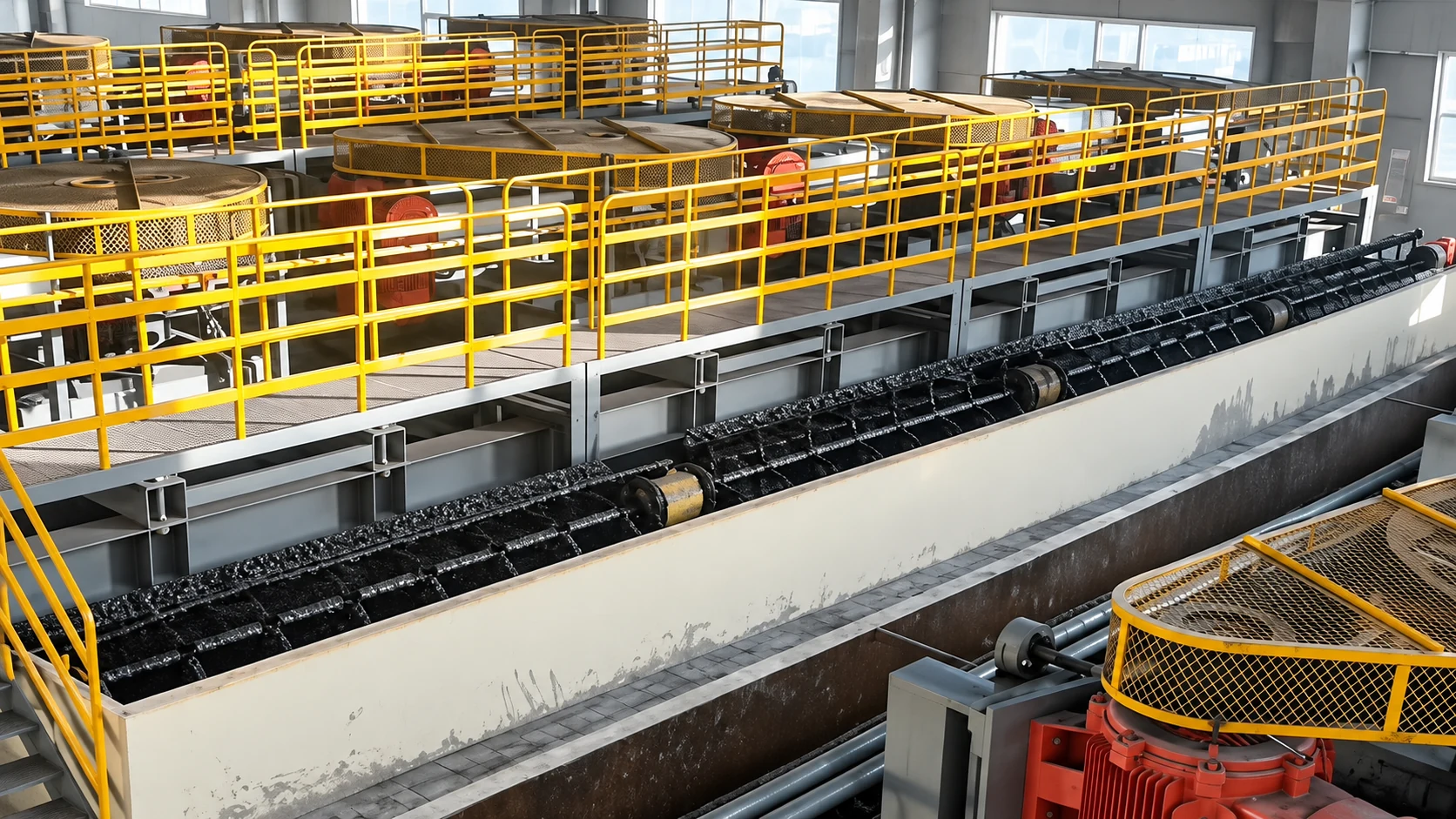
Collector selection for phosphate direct flotation starts with ore mineralogy and process route, not collector dosage alone. In a direct-flotation circuit, the objective is to make the valuable phosphate mineral—commonly apatite—sufficiently hydrophobic to report to the froth while limiting the recovery of unwanted carbonate and silicate gangue. That balance depends on the collector chemistry, pH, depressant system, particle size, water chemistry and the degree of mineral liberation.
QINGQUAN supplies a Phosphate Positive Flotation Collector for phosphate ore positive flotation. Its product page identifies a long-chain fatty-acid-based composition direction and a light-yellow paste-like appearance. Those product facts provide a starting point for technical discussion, but the working dosage, pH window and grade-recovery response still need to be confirmed on representative ore.
What Does a Collector Float in Phosphate Direct Flotation?
In phosphate direct flotation, the valuable phosphate mineral is the intended floated product. A collector adsorbs on suitable mineral surfaces and increases their hydrophobicity so that they can attach to air bubbles and enter the froth. This is different from a reverse-flotation route, where the gangue is floated and the phosphate mineral is retained in the non-froth product.
The distinction matters because the same phrase—“phosphate flotation collector”—does not define the actual separation duty. Before comparing reagents, the plant should identify whether the circuit is direct flotation, reverse flotation or a flowsheet that combines both. QINGQUAN lists a separate Phosphate Reverse Flotation Collector, which reinforces the need to define the process route before discussing reagent selection.
| Process route | Material intended to float | Main selection question |
|---|---|---|
| Direct phosphate flotation | Valuable phosphate mineral such as apatite | Can the collector recover phosphate while limiting gangue recovery? |
| Reverse phosphate flotation | Selected carbonate or silicate gangue | Can the reagent reject gangue while retaining phosphate in the non-froth product? |
A useful collector trial therefore begins with a clearly defined product stream and target. “Higher recovery” is not automatically a better result if the additional froth also carries too much calcite, dolomite, quartz or other unwanted material.
Which Ore Minerals Control Collector Selectivity?
Apatite, Calcite and Dolomite
One of the main challenges in phosphate flotation is the chemical similarity between apatite and calcium-bearing gangue such as calcite and dolomite. All contain calcium-bearing surface sites, so fatty-acid-type collectors can interact with more than one mineral. This is why a collector that gives strong apatite recovery in a single-mineral test may show poorer selectivity on an actual ore containing carbonate gangue.
The plant should therefore identify not only the feed P2O5 grade but also which minerals carry phosphorus, calcium and magnesium. If magnesium is mainly associated with dolomite, for example, the reagent strategy may need to address a different selectivity problem than a quartz-dominant feed.
Bulk assays alone can hide this difference. Two ores with similar P2O5 and MgO may still behave differently if one contains liberated apatite and dolomite while the other contains fine intergrowths. For a high-quality collector study, mineralogical information should be reconciled with size-by-size chemical assays so that a change in recovery can be linked to the minerals that actually moved into the froth.
Quartz, Liberation and Fine Particles
Silicate gangue presents a different surface-chemistry problem, but liberation remains just as important. A collector cannot separate minerals that are still locked together in the same particle. If apatite is finely intergrown with quartz or carbonates, additional collector may increase mass pull without solving the underlying liberation limit.
Fine particles and slimes also change reagent behavior. They increase total surface area, can coat valuable minerals, consume reagents and alter froth entrainment. For this reason, a phosphate ore flotation collector should be evaluated together with particle-size distribution and mineral liberation, not against a bulk chemical assay alone.
| Ore feature | Why it matters | Useful evidence |
|---|---|---|
| Apatite with calcite/dolomite | Similar calcium-bearing surfaces can reduce collector selectivity | Mineralogy, MgO/CaO deportment, concentrate assays |
| Quartz-rich gangue | Requires a different selectivity balance from carbonate-rich ore | Mineralogy, size-by-size SiO2 data |
| Poor liberation | Collector chemistry cannot fully separate locked particles | Liberation analysis by size fraction |
| High slime content | Can increase reagent consumption and entrainment | Fine-fraction analysis and froth observations |
How Do Collector Chemistry, pH and Depressants Work Together?
Phosphate flotation is controlled by a reagent system rather than by the collector alone. Fatty-acid-based collectors are widely used for apatite flotation because their polar groups can interact with mineral surface sites while their hydrocarbon chains create hydrophobicity. Their performance, however, is strongly affected by solution chemistry.
pH influences both the mineral surface and the chemical form of the collector. It also changes the way depressants and dissolved ions interact with the minerals. As a result, a dosage comparison made at different pH values may actually be comparing two different flotation environments.
The depressant system is equally important. If a gangue mineral is insufficiently depressed, increasing collector dosage can raise gangue recovery together with phosphate recovery. If the valuable mineral is over-depressed, more collector may fail to restore the desired response efficiently. A technically meaningful trial should therefore record collector dosage, depressant type and dosage, conditioning sequence, pH and conditioning time as one reagent scheme.
QINGQUAN’s Phosphate Positive Flotation Collector is described as containing long-chain fatty acids and as water-soluble. Those points can guide preparation and product identification, but they do not establish a universal optimum pH or dosage. Those values should come from ore-specific testing.
Conditioning sequence is another source of misleading comparisons. If a depressant, pH modifier and collector are added in a different order or allowed different conditioning times, the surface presented to the collector may no longer be equivalent. When screening products, the reagent sequence should therefore be held constant unless the sequence itself is being investigated.
How Do Slimes, Water Chemistry and Temperature Change Collector Response?
A collector that performs consistently in fresh laboratory water may behave differently when a plant increases recycle-water use. Dissolved calcium, magnesium, iron and other ions can interact with mineral surfaces and reagents. Residual depressants, dispersants and other process chemicals can also accumulate in closed or partially closed water circuits.
For this reason, water chemistry should be treated as a process variable. When plant performance changes after a water-source change, useful comparisons include conductivity, hardness or relevant ion analyses, recycle-water proportion and residual reagent conditions. The objective is not to blame the water automatically, but to determine whether the flotation environment has changed enough to alter collector response.
Temperature can also affect reagent preparation, collector solubility and flotation kinetics. QINGQUAN’s product page lists a freezing-point reference for the specific product, but that value should not be converted into a claim about the best pulp temperature. Product storage and preparation conditions should be recorded separately from flotation pulp temperature.
Which Test Results Support a Collector Choice?
A collector should move forward because it produces a repeatable separation under defined conditions—not because it produces the largest froth or the highest recovery in one test. The most useful evaluation keeps feed, grind, water, conditioning and reagent conditions comparable and looks at grade and recovery together.
For a phosphate direct-flotation trial, the minimum record should usually include:
- feed and concentrate P2O5;
- key gangue indicators such as MgO, SiO2 or other site-relevant impurities;
- phosphate recovery and mass pull;
- collector and depressant dosage on a clearly stated basis;
- pH, temperature and water source;
- particle-size distribution and relevant liberation information;
- froth handling observations and test repeatability.
The grade-recovery relationship is especially important. A collector that increases recovery but sharply increases carbonate or silicate recovery may not improve the final process. Conversely, a very selective concentrate with excessive phosphate loss may not be acceptable either. The meaningful choice is the reagent regime that best meets the plant’s target product specification and recovery objective under comparable conditions.
Sampling and mass balance quality also matter. If the feed or froth sample is not representative, an apparent improvement in P2O5 recovery can come from sampling error rather than flotation chemistry. For trials that will influence purchasing decisions, repeat runs and a basic mass-balance check are more valuable than adding more reagent variants without replication.
| Trial result | Question it answers |
|---|---|
| P2O5 grade and recovery | Is valuable phosphate being recovered at the required concentrate quality? |
| MgO / SiO2 or other impurity data | Is increased recovery also bringing more gangue into the concentrate? |
| Mass pull | Is the collector simply floating more total material? |
| Dosage and conditioning conditions | Can the result be reproduced and compared fairly? |
| Water source and temperature | Were important operating conditions held constant? |
The product page also lists the collector as a light-yellow paste-like solid with a freezing-point reference below 5-7 °C. In practice, storage and preparation observations should be separated from flotation performance: a handling issue in cold storage should not be interpreted as a change in ore selectivity without a controlled comparison.
When comparing a broader reagent portfolio, QINGQUAN’s flotation reagents for mineral processing page can help identify the correct product family before a plant moves to product-specific trials.
What Should You Confirm Before Testing a Commercial Phosphate Collector?
A useful supplier discussion starts with process data. Sending only “phosphate ore” and a target dosage gives too little information to evaluate selectivity. A plant should ideally provide:
- ore mineralogy and available feed assays;
- direct, reverse or combined flotation route;
- grind and particle-size information;
- current collector, depressant and other reagents;
- current dosage basis and conditioning sequence;
- pH, temperature and water source;
- current concentrate grade, recovery and main impurity problem;
- target grade or recovery;
- sample availability and required product documents.
These inputs allow a commercial collector to be tested against the actual separation problem rather than against a generic phosphate label. They also help distinguish a chemistry problem from a liberation, water-quality or operating-condition problem.
QINGQUAN asks users of its Phosphate Positive Flotation Collector to provide ore type, process route, current reagent, dosage, pH, temperature and target grade or recovery. If you are preparing a plant trial, you can discuss your phosphate flotation conditions with QINGQUAN and request the relevant product-specific TDS, MSDS, COA and quotation information.
For phosphate direct flotation, the central question is not which collector has the strongest collection power in isolation. It is which collector system can recover apatite selectively under the ore’s real mineralogical, water and operating conditions. Defining those conditions first makes laboratory results easier to interpret and commercial trials more useful.