
Composite Carbon Sources for Wastewater Denitrification: Dosage, Kinetics and Control
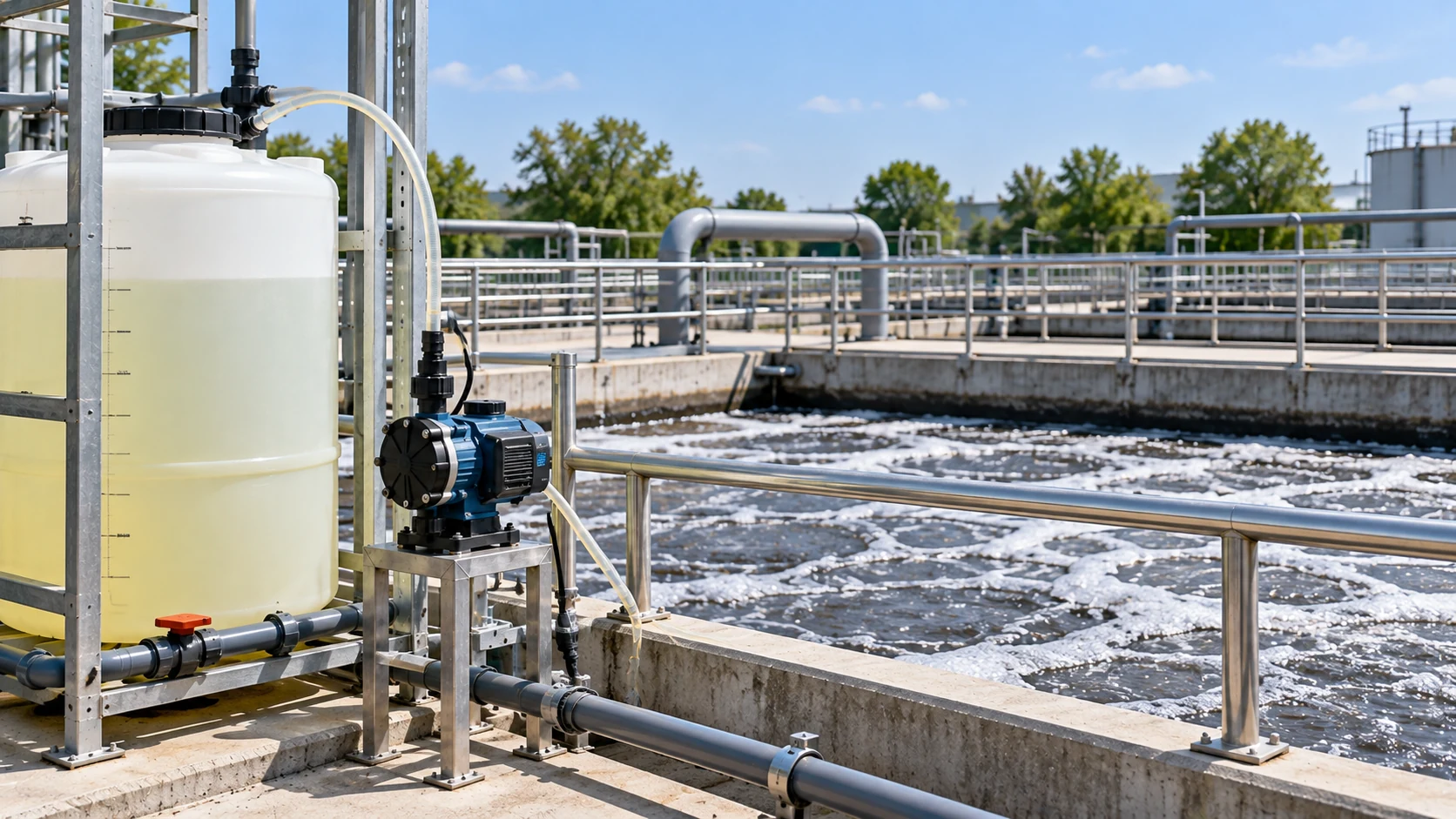
An external carbon source is useful in wastewater denitrification when the anoxic zone does not have enough readily biodegradable carbon to reduce the nitrate and nitrite load at the required rate. The correct dose cannot be set from a universal L/m³ value: it depends on nitrogen load, available internal carbon, the COD contribution of the commercial product, process configuration, temperature, biomass condition and the effluent target.
QINGQUAN supplies a Composite Carbon Source for wastewater denitrification. Its product page describes a multi-component formulation based on biological enzymes, short-chain alcohols/acids, microbial promoters and microbial nutrients, with a light-yellow or colorless transparent liquid appearance. Those facts identify the product direction, but product-specific COD concentration, dosing range and plant response should be confirmed from the relevant technical documents and site testing.
When Does a Denitrification Process Need External Carbon?
Denitrifying microorganisms need a usable electron donor to reduce nitrate and nitrite to nitrogen gas. In many biological nutrient-removal systems, some of that carbon comes from the wastewater itself. The amount still available in the anoxic zone, however, depends on where the zone is located and how much biodegradable organic matter has already been consumed upstream.
A pre-anoxic zone can receive influent wastewater with a meaningful fraction of readily biodegradable COD, while a post-anoxic zone or denitrifying filter often receives water after much of the original organic load has already been removed. In that situation, supplemental carbon is more likely to become the limiting input.
Plants should therefore diagnose carbon limitation from the actual process rather than from influent COD alone. High total COD at the plant inlet does not prove that the downstream anoxic biomass has enough rapidly usable substrate.
| Process condition | Carbon-availability question | What to verify |
|---|---|---|
| Pre-anoxic biological nitrogen removal | How much readily biodegradable influent carbon reaches the anoxic zone? | Influent COD/BOD fractions, recycle flow, nitrate load, DO carryover |
| Post-anoxic zone | Has upstream treatment already consumed most biodegradable carbon? | Anoxic influent nitrate/nitrite, residual COD, flow and contact time |
| Denitrifying filter | Is an external substrate needed to support the target nitrate-removal rate? | Filter loading, nitrate load, effluent target and current dose |
| Variable industrial wastewater | Does carbon availability fluctuate with production conditions? | Time-series COD, nitrogen and flow data |
What Should You Compare in a Composite Carbon Source?
Two products with the same delivered volume may not provide the same usable carbon to the biomass. A technically useful comparison considers the carbon that is actually available for denitrification, how quickly the microorganisms can use it, and how consistently the product is delivered from batch to batch.
Important comparison points include:
- product COD concentration and the method used to report it;
- biodegradability and denitrification kinetics;
- biomass yield and possible sludge-production impact;
- viscosity, solids content and pumping behavior;
- storage stability and low-temperature handling;
- safety and materials compatibility;
- batch-to-batch composition consistency.
Commercial carbon sources can include single compounds such as methanol, ethanol or acetate as well as proprietary multi-component formulations. The correct comparison is not “which ingredient is best” in isolation; it is which product provides the required denitrification performance with manageable handling, dosing and residual-COD risk under the plant’s conditions.
QINGQUAN describes its Composite Carbon Source as a multi-component denitrification carbon supply. The published page does not provide the product-specific COD concentration or a universal COD:N requirement, so those values should be requested and confirmed before a dose calculation is converted into a volumetric feed rate.
How Should the Initial Carbon Dose Be Established?
Start with the Nitrogen Load
The dose should start from the amount of nitrate and nitrite that must be removed, not from wastewater volume alone. For a given operating period, the plant needs the flow, nitrogen concentration entering the carbon-fed zone and the target nitrogen concentration leaving it. That information defines the nitrogen-removal load that the external carbon source must help support.
The calculation also needs to consider how much readily biodegradable internal carbon is already available and whether dissolved oxygen entering the anoxic zone is consuming part of the electron-donor demand. If significant oxygen is carried into the zone, additional carbon can be consumed without contributing directly to nitrate reduction.
Normalize the Dose on a COD Basis
Before comparing commercial products, normalize their contribution to a consistent COD basis. A product sold as a liquid volume cannot be compared fairly with another product by L/m³ alone unless their COD concentrations are known. Likewise, a kg/day comparison is incomplete if one product contains much more usable carbon per kilogram.
A practical calculation framework is:
The COD:N ratio used for the initial estimate should come from an appropriate design basis, bench test or plant history for the actual carbon source and process. It is not a universal constant. Carbon-source chemistry, biomass yield, acclimation, temperature, sludge age and process configuration all affect the real consumptive ratio.
Once the required COD input is estimated, it can be converted to product mass or volume only after confirming the product’s actual COD concentration and density or other relevant dosing data.
| Input | Why it matters |
|---|---|
| Flow and NO3-N / NO2-N load | Defines the nitrogen-removal duty |
| Internal readily biodegradable COD | Reduces the external-carbon requirement when it is actually available in the anoxic zone |
| DO entering the anoxic zone | Can consume electron donor without removing nitrate |
| Product COD concentration | Converts COD demand into a commercial dose |
| Temperature and SRT | Affect biological kinetics and adaptation |
How Do Temperature and Biomass Change Carbon Demand?
Denitrification is biological, so the same chemical dose does not guarantee the same nitrate-removal rate throughout the year. Temperature affects microbial reaction rates. Solids retention time, biofilm or suspended-growth configuration, and the population already acclimated to a particular substrate can also change how quickly a carbon source is used.
A sudden switch from one carbon source to another may therefore produce a temporary response that is different from steady-state performance. When comparing carbon sources, operators should record the acclimation period and avoid treating the first few hours or days as fully representative if the biomass is still adapting.
Changes in hydraulic or nitrogen loading can create a similar interpretation problem. If nitrate load rises at the same time that a new carbon source is introduced, an unchanged effluent concentration does not mean the new product has the same kinetics. The carbon input and nitrogen-removal load should be evaluated together.
How Can Operators Detect Underdosing and Carbon Overfeed?
Good control looks at both sides of the denitrification reaction: the nitrogen that should be removed and the residual carbon that may leave the process. A low dose can leave nitrate or nitrite above the target. An excessive dose can leave residual COD and create downstream oxygen demand or carbon breakthrough.
| Observed condition | Possible causes to investigate | First checks |
|---|---|---|
| NO3-N remains high | Insufficient usable carbon, high DO carryover, inadequate contact time, low temperature or insufficient active biomass | Dose, COD basis, DO, temperature, flow and anoxic residence time |
| NO3-N meets target but effluent COD rises | Carbon overfeed, changed product concentration, lower nitrogen load or poor feed control | Product concentration, pump calibration, nitrogen load and dosing logic |
| NO2-N accumulates | Incomplete denitrification, kinetic imbalance or changing process conditions | Carbon dose, DO, pH, temperature and biomass condition |
| Performance fluctuates after a batch change | Composition, COD concentration, viscosity or feed-system variation | COA/TDS data, dosing-pump output and batch comparison |
These observations are diagnostic directions, not one-to-one fault codes. A high nitrate result should not automatically be treated with more carbon before oxygen intrusion, contact time and biomass condition are checked. Likewise, high COD should not be attributed to carbon-source overfeed without confirming other COD contributors.
Why Does Product Consistency Matter in Carbon-Source Selection?
In a continuously dosed denitrification system, a commercial carbon source is part of the process-control loop. Variability in the product can therefore appear as variability in plant performance even when the pump setpoint has not changed.
Useful quality parameters depend on the product, but the plant should understand which characteristics control the actual COD delivered and whether viscosity, suspended material or phase stability can affect dosing equipment. If a product thickens significantly in cold storage or contains variable suspended solids, the nominal pump setting may no longer represent the same effective chemical feed.
| Product characteristic | Possible operating impact |
|---|---|
| COD concentration variability | Changes the COD actually delivered at a fixed volumetric dose |
| Viscosity | Can change pump calibration and transfer behavior |
| Suspended material | May affect strainers, tubing or feed equipment |
| Phase stability | Can affect dose consistency if the product separates during storage |
| Low-temperature behavior | May affect storage, transfer and metering |
Formal product limits should come from the relevant TDS and COA rather than from generic carbon-source assumptions. QINGQUAN’s product page invites plants to provide water-quality and process data so that product-specific documents and application guidance can be matched to the project.
How Should a Plant Compare Composite Carbon Source with Sodium Acetate?
A plant already using sodium acetate should compare a composite carbon source on the same process and performance basis. The fair question is not whether one product has a lower L/m³ dose. The fair question is how much usable COD is delivered, how the biomass responds, what nitrogen-removal result is achieved, what residual COD remains, and what the handling and cost implications are.
QINGQUAN also supplies a Sodium Acetate Solution for wastewater carbon supplementation. A controlled comparison can therefore be organized around:
- the same wastewater or comparable operating period;
- the same nitrogen-removal target;
- normalized COD input;
- NO3-N and NO2-N response;
- effluent COD;
- sludge or biofilm response where relevant;
- pump, storage and handling requirements;
- cost per unit of nitrogen removed rather than product price alone.
Neither carbon source should be declared universally superior without this common basis. Plants can also review QINGQUAN’s broader water-treatment chemicals range when the operating problem involves more than carbon deficiency.
What Data Should Be Sent Before a Carbon-Source Trial?
Carbon-source trials are more useful when the supplier sees the actual nitrogen-removal duty and operating conditions before a dose is proposed. A plant should prepare, where available:
- average and peak flow;
- NO3-N and NO2-N entering and leaving the carbon-fed zone;
- COD/BOD and available information on biodegradable fractions;
- NH4-N and total-nitrogen targets;
- process configuration and dosing point;
- temperature, pH, DO and SRT or relevant biomass information;
- current carbon source, concentration and dosage;
- current operating problem, including residual nitrate, nitrite or COD;
- required product documents and packaging constraints.
QINGQUAN asks users of its Composite Carbon Source to provide a water-quality report, system type, current chemical, dosage, operating issue and target result. If you are preparing a bench or plant comparison, you can share your wastewater conditions with QINGQUAN and request product-specific TDS, MSDS, COA and quotation information.
For wastewater denitrification, stable carbon dosing is not achieved by selecting one universal dose. It comes from matching the nitrogen load, usable COD, microbial kinetics and product consistency to the actual process, then controlling the feed with both nitrogen and residual-carbon results.