
How to Choose Magnesite Flotation Collectors for Silicate Removal
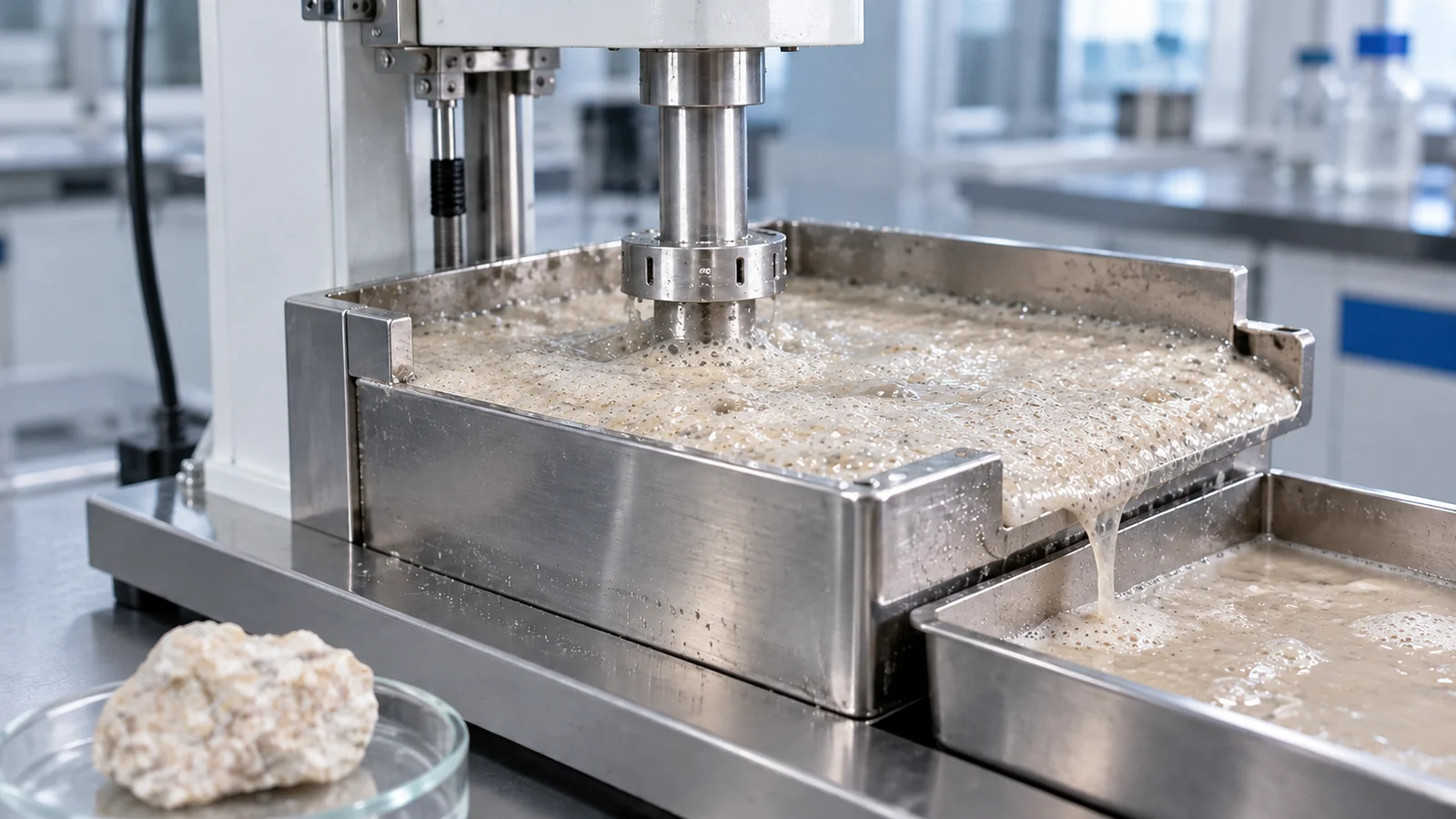
Magnesite flotation collectors used for desilication by reverse flotation must preferentially move unwanted silicate minerals into the froth while retaining magnesite in the non-floating product. Success means reducing the relevant impurities with an acceptable loss of valuable mineral. More froth, a lower silica assay, or a higher reported MgO grade cannot establish that result on its own.
QINGQUAN lists its Magnesite Collector for reverse-flotation desilication and dealumination. Evaluating that product starts with identifying the minerals that carry silicon and aluminium, defining the required concentrate quality, and measuring what leaves with the froth. The collector must be assessed within the intended ore and reagent system.
Separate Silicate Removal from Carbonate Separation
Quartz and Talc Require Different Assessments
Quartz and talc can both contribute to an ore’s reported SiO₂ content, but their flotation behaviour is different. Quartz is silica, whereas talc is a magnesium-bearing silicate. Talc’s basal surfaces can be naturally hydrophobic; its response also depends on surface condition and mineral composition. A collector comparison focused only on quartz therefore does not establish how a talc-bearing ore will behave.
Identify which minerals are being removed, rather than treating every decrease in SiO₂ as the same separation result. Examine the feed and both flotation products using suitable mineralogical analysis alongside chemical assays. Where quartz and talc occur together, determine whether the candidate removes both or mainly the easier-floating fraction.
Liberation matters as well. A silicate grain locked inside a magnesite particle cannot be separated from that particle by collector selectivity alone. Check whether residual silica reflects insufficient liberation before responding simply by increasing collector dosage.
Dolomite Is a Separate Impurity Problem
Dolomite is a calcium–magnesium carbonate, not a silicate. Removing quartz or talc does not demonstrate that dolomite has also been removed. A concentrate can meet its silica target and still fail its calcium requirement.
Define whether the immediate task is desilication alone or whether calcium-bearing minerals must also be rejected. Track CaO separately from SiO₂ and identify the calcium-bearing phases. A desilication result should not be presented as evidence that every impurity has been controlled.
This distinction also affects flowsheet decisions. Some ores may require an additional separation step to meet the final product specification. The need for that step should follow from the mineral composition and test results, rather than from a blanket assumption that every magnesite ore requires the same process.
Explain Why Mineral Chemistry Changes Collector Response
Carbonate Dissolution Can Change the Pulp Environment
Magnesite and dolomite can dissolve in acidic water, releasing ions and changing the chemical environment in which flotation occurs. The pulp is therefore a reacting mineral–water system, not simply water adjusted to a chosen pH.
Record the pH after the ore and reagents have been conditioned, together with the conditioning time and the identity of the pH modifier. An initial water pH does not necessarily describe the conditioned pulp during flotation.
Water chemistry should also be part of the comparison. If a plant uses recycled water, representative process water belongs in the trial programme. Where carbonate dissolution is significant, investigate dissolved magnesium and calcium as well as the solid products; a solids-only balance may otherwise leave part of the material loss unexplained.
pH Affects the Reagent–Mineral System
For protonatable amine collectors, pH influences the balance between charged and uncharged reagent species. It also affects mineral surface charge and solution chemistry. These effects must be considered together when judging preferential adsorption on silicates rather than magnesite.
Published studies have evaluated different amine-based collectors under different pH conditions. Their results support testing a defined reagent–ore combination; they do not establish one universal operating pH for magnesite reverse flotation.
The QINGQUAN product page does not identify the collector’s chemical formulation. Buyers should obtain the applicable technical guidance before assigning it an amine mechanism or importing operating conditions from a paper about another reagent.
Select Regulators for the Intended Mineral Response
Retain Magnesite While Floating the Target Gangue
A regulator is useful when it helps establish the required separation direction. In a desilication step, that normally means retaining magnesite while allowing the target silicate gangue to float. Any response of dolomite must be assessed against the separate calcium-removal objective.
A regulator that retains magnesite but also retains dolomite may support silica removal while leaving the calcium problem unresolved. Conversely, a scheme that floats more calcium-bearing material needs checking for accompanying magnesite loss. The preferred direction depends on which minerals must leave the product.
In one published ether-amine study, sodium hexametaphosphate promoted dolomite flotation at lower tested concentrations but depressed it at higher concentrations. This illustrates why a reagent’s name alone cannot predict its function. The finding belongs to that experimental system and is not a dosage instruction for another collector.
Verify the Complete Reagent Combination
Evaluate the collector with the actual regulators and other reagents proposed for the circuit. Record their addition order, preparation method, dosage basis, and conditioning times. A product comparison is difficult to interpret when several of these conditions change without being tracked.
For a QINGQUAN Magnesite Collector trial, include the existing reagent scheme and its baseline results in the technical enquiry. This establishes whether the intended change is a collector substitution within the current process or a broader adjustment to the reagent combination.
Single-mineral tests can help explain adsorption and selectivity, but representative ore tests are needed to assess the combined effect of mineral associations and fines. Record dry product masses and assays. Froth volume or appearance alone cannot show how much silicate has been removed or how much magnesite has been lost.
Verify What Lower Silica and Higher MgO Actually Mean
Keep Raw-Ore and Ignited-Basis Assays Separate
Before comparing feed and concentrate, establish whether the assays are reported on an uncalcined dry basis, an ignited basis, or another stated basis. Magnesite is MgCO₃. On calcination, it releases carbon dioxide and forms MgO, reducing the mass against which the remaining components are expressed.
An MgO percentage reported on an ignited or loss-on-ignition-free basis can therefore be substantially higher than the value for the same uncalcined sample. That difference does not, by itself, represent impurity removal by flotation.
In an uncalcined ore assay, “MgO” commonly expresses the magnesium content as an oxide equivalent; it does not mean that all magnesium is present as free magnesium oxide. Keep this reporting convention separate from the mineral composition.
Ask the laboratory to identify the moisture basis, loss-on-ignition method, and any normalisation used. Compare feed with concentrate on the same basis. Do not combine an ignited-basis grade with an uncalcined dry mass in a recovery calculation without the appropriate conversion.
Distinguish MgO Recovery from Magnesite Mineral Recovery
MgO-equivalent recovery measures how much magnesium, expressed as MgO, remains in the selected product. It does not identify the mineral carrying that magnesium. Dolomite and talc also contain magnesium, so their contribution matters when interpreting the result.
Removing magnesium-bearing gangue can reduce total MgO-equivalent recovery even when part of that reduction represents the intended impurity rejection. Conversely, retaining dolomite or talc can increase the reported magnesium recovery while leaving unwanted minerals in the concentrate.
Use the following checks to keep the interpretation clear:
| Reported result | What it can establish | What it cannot establish alone |
|---|---|---|
| Lower concentrate SiO₂ | Less silica equivalent per unit of product on the stated basis | Which silicate minerals were removed or how much magnesite was lost |
| Higher concentrate MgO | A higher magnesium oxide equivalent proportion | That the change came entirely from flotation or greater magnesite purity |
| MgO-equivalent recovery | The fraction of feed magnesium retained, using a consistent mass and assay basis | Recovery of the magnesite mineral specifically |
| Lower concentrate CaO | Less calcium oxide equivalent per unit of product | Complete dolomite removal or satisfaction of every impurity requirement |
| Mineral-specific recovery | Retention or rejection of an identified mineral | A reliable result without representative sampling and quantitative mineralogical support |
Weigh and assay the non-floating magnesite product and the froth reject against the same feed. Combine these results with appropriate quantitative mineralogical information when a mineral-specific recovery claim is needed. Treat unaccounted magnesium as a balance issue to investigate, rather than automatically assigning it to magnesite lost in the froth.
Define the Limits of Desilication and Dealumination
Identify Which Minerals Carry Aluminium
An Al₂O₃ assay describes aluminium expressed as an oxide equivalent; it does not identify its mineral host. Aluminium may occur in different silicate phases or within mineral structures, and those occurrences need not respond to a collector in the same way.
Determine which aluminium-bearing phases are present, whether they are sufficiently liberated, and whether they report to the froth in the proposed test. If silica falls while alumina remains largely unchanged, investigate the host minerals and product distribution before assuming that a higher collector dose will resolve the difference.
Match Product Claims to Ore-Specific Evidence
The QINGQUAN Magnesite Collector is listed for desilication and dealumination in magnesite reverse flotation. That application description provides a relevant starting point for product enquiries. It does not establish removal efficiency for every aluminium-bearing mineral or every ore blend.
Specify the required SiO₂, Al₂O₃, and CaO limits separately. Ask which available product information and test evidence apply to the identified mineral assemblage. Where the mineral response remains uncertain, make it an explicit objective of the sample trial.
Prepare a Mineral-Specific Collector Trial Brief
Prepare the following information before comparing products or requesting samples:
- Mineralogy: magnesite, quartz, talc, dolomite, and other identified phases, including the hosts of aluminium.
- Assays and bases: feed, retained product, and froth-reject results; dry masses; moisture and loss-on-ignition information; and any normalisation applied.
- Current process: grinding and flotation stages, particle-size distribution, reagent identities, addition sequence, and dosage bases.
- Operating conditions: measured pulp pH, pH modifier, temperature, conditioning times, and water source or analysis.
- Performance targets: individual impurity limits, acceptable magnesium loss, and whether recovery must be established for magnesite specifically.
- Product requirements: sample quantity and the relevant technical data sheet, safety data sheet, and certificate-of-analysis information.
A useful magnesite reverse-flotation result connects impurity removal to the minerals removed and the valuable mineral retained. To discuss a collector trial, contact QINGQUAN with your mineralogy, assay results, and operating conditions. Use that information to define a test that can distinguish successful desilication from avoidable magnesite loss.