
How to Choose Fluorite Flotation Collectors for Calcite Rejection
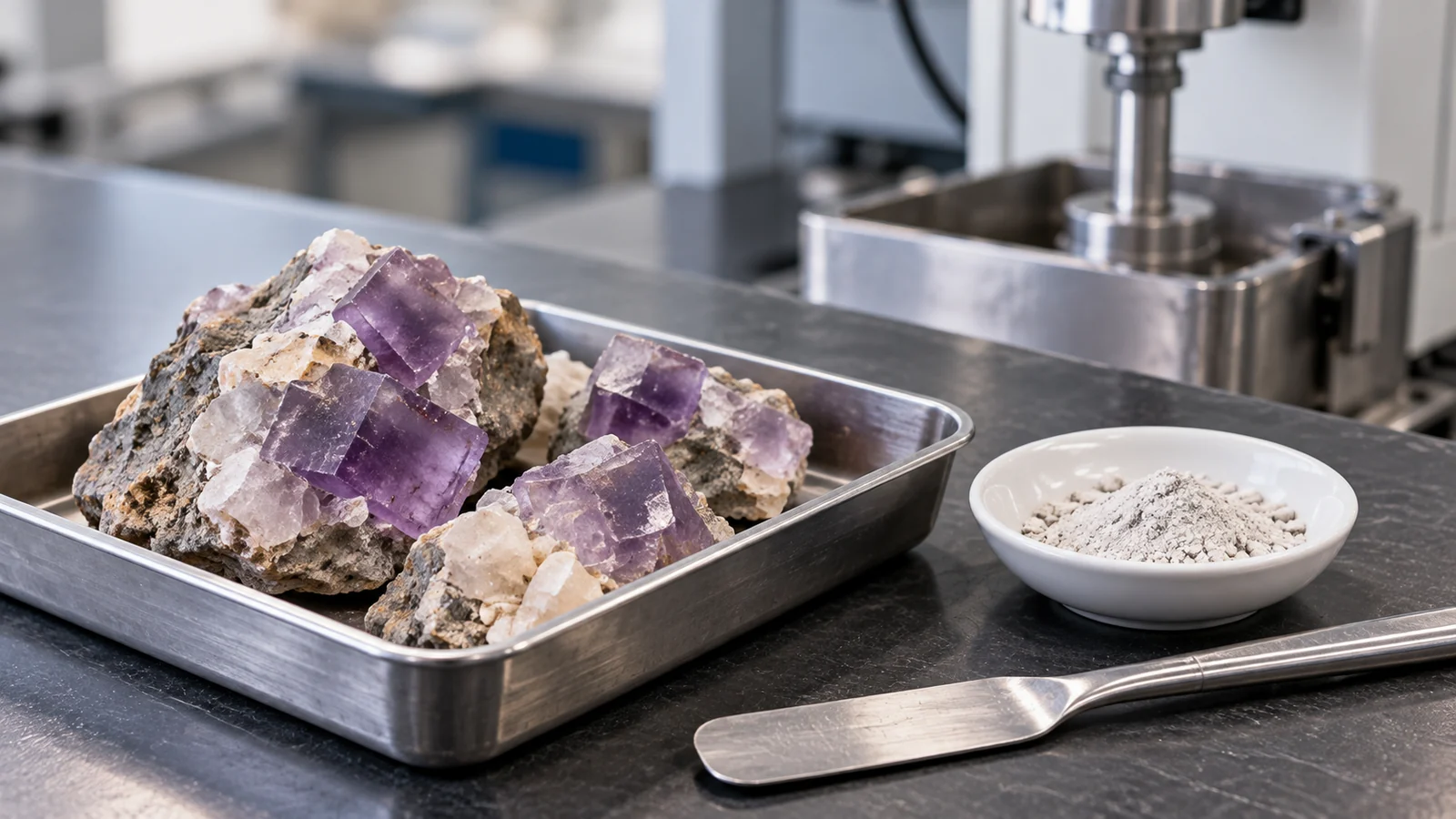
Fluorite flotation collectors should be evaluated by how well they recover fluorite while limiting calcite in the concentrate. Higher recovery must be judged alongside the concentrate’s impurity requirements and its role in the process. That balance depends on mineral liberation, the collector–depressant combination, and the water and operating conditions used in the test.
QINGQUAN offers a Fluorite Collector for fluorite beneficiation. For a plant considering this product, the starting point is an ore-specific comparison against its current reagent system. The practical question is whether the candidate can improve the acceptable balance between CaF₂ recovery and calcite rejection under representative conditions.
Why Fluorite Recovery Alone Does Not Prove Selectivity
Fluorite and Calcite Can Respond to the Same Collector
Fluorite and calcite are both calcium-bearing minerals. With a commonly studied fatty acid collector such as sodium oleate, both can become sufficiently hydrophobic to attach to bubbles. A reagent that collects fluorite strongly may therefore also float unwanted calcite.
Selective fluorite flotation requires a useful difference between the two minerals’ responses. A suitable depressant can help reduce calcite flotation while preserving fluorite floatability, but the result depends on the particular reagent system and conditions. Laboratory findings for a named collector and depressant do not establish the formulation or performance of a commercial product.
Higher Mass Recovery Can Also Mean More Gangue
Concentrate mass yield is the proportion of feed solids recovered into concentrate. Fluorite recovery is the proportion of feed fluorite recovered there. These measurements answer different questions.
If concentrate mass increases, check whether CaF₂ grade and calcite content have changed. More collected solids may include additional fluorite, additional gangue, or both. Even an improvement in fluorite recovery can be commercially unsuitable if calcite contamination rises beyond the buyer’s specification.
Judge a candidate at a defined concentrate quality target. Alternatively, compare concentrate quality at a similar fluorite recovery. Either approach is more informative than comparing each reagent only at the condition giving its highest recovery.
Identify What Is Preventing Fluorite–Calcite Separation
Check Liberation Before Changing Collector Dosage
A collector acts on exposed particle surfaces. It cannot separate fluorite and calcite that remain physically joined inside the same particle. Where fluorite-bearing composite particles float, attached calcite may enter the concentrate even when the reagent system discriminates between liberated mineral surfaces.
Examine representative feed, concentrate, and tailings samples to identify where fluorite and calcite occur and whether they are liberated. If contamination is concentrated in composite particles, investigate liberation and the circuit’s treatment of those particles before attributing the problem entirely to collector choice.
Finer grinding also needs evaluation rather than automatic adoption. It changes particle size as well as liberation, so any benefit must be checked against the flotation response of the newly generated fine material.
Separate Calcite Contamination from Other Gangue Problems
Calcite, quartz, and other gangue minerals should be tracked separately. A fall in silica does not demonstrate better calcite rejection, and a bulk impurity result does not identify which particles entered the concentrate.
Fine gangue can also reach the froth through entrainment: particles travel with recovered water without needing selective collector attachment. This means that concentrate contamination may reflect mineral flotation, composite-particle recovery, water carryover, or a combination of mechanisms.
Use mineral identification and size-by-size observations alongside chemical assays. Where fine gangue carryover is suspected, record water recovery and relevant froth conditions during comparison tests. These observations help distinguish a reagent-selectivity problem from a change in how much water and fine material the froth carries.
Evaluate the Collector and Depressant as a Reagent System
Preserve Fluorite Floatability While Depressing Calcite
The purpose of a depressant is to reduce unwanted mineral flotation within the chosen process. Its value must be assessed alongside the fluorite that remains recoverable. Stronger calcite depression is not a satisfactory outcome if it produces an unacceptable fluorite loss.
Start with a baseline representing the current plant reagent scheme. Screen collector changes under controlled conditions, then investigate collector–depressant combinations where the results justify doing so. A single test with a fixed depressant dose cannot establish the best achievable balance for every candidate collector.
For QINGQUAN’s Fluorite Collector, supply the identity and dosage of the current depressant as part of the trial brief. Compatibility with an existing reagent scheme needs confirmation through the relevant product information and representative ore tests.
Check Dosage, Addition Order, and Conditioning Together
Record reagent preparation, addition order, and the conditioning time between additions. These determine the conditions under which reagents contact mineral surfaces. Comparisons become difficult to interpret when a new collector is introduced together with unrecorded changes to the rest of the procedure.
State the dosage basis explicitly, for example grams of supplied product per tonne of dry ore. Products may differ in active content, so equal supplied-product dosages do not necessarily represent equal amounts of active reagent. Compare on an active basis only when that information is available and comparable.
Keep a baseline test within the programme and repeat promising conditions. This helps establish whether an apparent improvement is reproducible rather than a result of sample or test variation.
Check pH, Water Chemistry, and Temperature Before Comparing Results
Treat pH and Process Water as Test Conditions
pH influences both reagent chemistry and the mineral–water interface. Dissolved ions can also affect the interactions involved in flotation. Consequently, a collector comparison made in one water supply should not automatically be transferred to another.
Record the pH-adjusting reagent and measured pulp pH at consistent stages. For a plant using recycled process water, include representative recycled water in the evaluation. A clean-water laboratory result may provide a useful starting point, but it does not resolve whether selectivity will persist in the operating circuit.
There is no universal best pH for every fluorite–calcite ore and collector combination. Define a test range from the existing process, ore characteristics, and product-specific guidance, then assess both fluorite recovery and calcite contamination within that range.
Distinguish Low-Temperature Handling from Separation Performance
A collector may be easier to prepare or disperse at low temperature without necessarily producing the required grade–recovery balance in a particular ore. Product handling and mineral separation therefore require separate checks.
The QINGQUAN Fluorite Collector page identifies low-temperature usability as an application consideration. Buyers should request the applicable preparation and operating guidance, then test the reagent at temperatures representative of their own process. That product description alone does not establish a guaranteed recovery, impurity level, or reagent consumption.
Record the temperature during preparation, conditioning, and flotation. If one reagent is tested warm and another cold, the results cannot isolate the effect of collector choice.
Read Trial Results as a Grade–Recovery Trade-Off
Compare Fluorite Recovery with Calcite Reporting
Use a small set of linked measurements to judge the result:
| Measurement | What it establishes | What to check alongside it |
|---|---|---|
| CaF₂ grade | Fluorite concentration in the product | Calcite and other required impurity limits |
| Fluorite recovery | How much feed fluorite reaches concentrate | Concentrate quality at that recovery |
| Calcite content and recovery to concentrate | The extent of calcite contamination and carryover | A suitable mineral-specific analytical basis |
| Dry concentrate mass yield | How much feed solid becomes concentrate | Whether the extra mass is valuable mineral or gangue |
| Reagent consumption | Product required under the tested conditions | Dosage basis and the resulting grade–recovery balance |
For the same defined feed and concentrate, fluorite recovery is calculated as:
Fluorite recovery (%) = 100 × (dry concentrate mass × concentrate CaF₂ grade) ÷ (dry feed mass × feed CaF₂ grade).
Use the same units for both masses and the same basis for both grades. Confirm that the reported CaF₂ assay represents fluorite; a value converted from total fluorine requires checking for other fluorine-bearing minerals. A corresponding mineral mass balance can describe calcite recovery into concentrate, provided calcite quantities have been reliably established. Calcite rejection from that concentrate is the complementary fraction of feed calcite that does not enter it.
Total calcium alone cannot identify calcite contamination because fluorite itself contains calcium. Likewise, a total-calcium result expressed as CaO is not automatically a calcite assay. Agree on an appropriate analytical method with the laboratory, accounting for the other calcium-bearing minerals present.
Use Consistent Sampling and Calculation Bases
Compare representative portions of the same ore sample and keep the circuit boundary clear. Rougher-concentrate recovery and final-concentrate recovery are different results; they should not be compared as though they describe the same separation stage.
Collect and assay the relevant product streams, use dry masses, and check whether the mass and component balances are consistent. An apparent improvement deserves investigation if the feed assay, recovered mass, and product assays do not reconcile within the laboratory’s agreed tolerances.
A laboratory screening result supports further testing under representative conditions. It should not be presented as an established plant result, especially where water recycling, circulating loads, or ore variability have not been represented.
Prepare an Ore-Specific Collector Trial Brief
A useful enquiry gives the supplier enough information to understand the separation task:
- Mineral composition, particle-size distribution, and available liberation information.
- Feed, concentrate, and tailings assays, including how CaF₂ and calcite were determined.
- Current flotation route, collector, depressant, and other relevant reagents, with dosage bases.
- Pulp pH, process temperatures, water source, and available water-analysis results.
- Target concentrate grade, impurity limits, and acceptable fluorite recovery.
- Sample availability and required technical data sheet, safety data sheet, and certificate-of-analysis information.
The appropriate fluorite flotation collector is the one that achieves an acceptable recovery–quality balance within the intended process. To discuss a candidate product, contact QINGQUAN with your ore and operating data and request the relevant documentation and sample information. Use those details to define a measurable comparison against the current reagent scheme.